After El Terremoto: Will Mexicans Mobilized for Disaster Relief, Now Organize for Political Change?

MEXICO CITY—I was in the bathroom when the shaking started, and at first I thought I had broken the toilet. Only two hours earlier the alarm sounded for an earthquake drill that takes place every year in memorial of the devastating 1985 terremoto. In a cruel form of irony, the city and surrounding communities were stuck on the same September 19th that 32 years ago took 10,000 lives. This tremor was not as strong, yet still collapsed 38 buildings and killed 360 people, including 219 in the capital and 28 children. Ordinary folks—many from a younger generation who grew up hearing stories of sacrifice—performed extraordinary acts of courage and service. Reminiscent of the citizen actions from ’85 that later overthrew seven decades of Institutional Revolutionary Party (PRI) rule, people are now asking if disaster will transform Mexican society once more.

IMG_9294

As the ground shook, all I could think of was when would the trembling stop. At Fundación IDEA’s office on the 11th floor in the city’s core, I spider-walked to the center column where my colleagues had huddled in el triángulo de la vida and hoped for the best. After we evacuated, we emerged into a sea of chaos. The stench of gas filled the air, and people yelled not to smoke, others called loved ones and embraced in support. Walking home down Reforma toward my neighborhood of Roma Norte, I had never seen so many people in the streets. I went down Calle Colima to check on friends (who were fine), and saw the front of a building in shambles on the sidewalk. Destruction was everywhere and people reacted in full force.

IMG_9260

Mexicans responded to the 7.1 magnitude earthquake (the second strong temor in 10 days) with expressions of compassion, grace and love. National solidarity plus social media became an equation for action. WhatsApp chat groups were consumed with activity, Centros de Acopio were overwhelmed with donations, and collapsed buildings were surrounded by volunteers in hard-hats and neon vests armed with shovels and buckets, anything that could be used to save lives. Acopio en Bici, avoiding traffic and traveling in silence around rescue sites, delivered supplies by biking hundreds of miles. Trendy restaurants opened their kitchens to feed hungry rescue workers and volunteers. And if you’re interested in helping, you can donate to Habitat for Humanity in Mexico or Los Topos, who formed after the ’85 earthquake and rescued numerous people. Yet while civil society and military support were welcomed, political actors and government assistance were met with suspicion.

IMG_9308

In the state of Morelos, the epicenter of the earthquake, the government has been accused of diverting aid packages to claim credit for new provisions. #RoboComoGraco, referring to the state’s Governor Graco Ramírez, trended on Twitter. Interior Minister Miguel Ángel Osorio Chong, a powerful member of an unpopular presidential cabinet, was forced out of a rescue site and heckled with chats of oportunista. President Enrique Peña Nieto was booed as he inspected a damaged pueblo, and someone shouted out “grab a shovel.” Corruption, ineptness, and impunity are sadly assumed with this government. The Enrique Rebsamen school, that collapsed killing 19 children and seven adults, was ordered to close twice because of construction irregularities on its fourth floor where the owner and principal lived. Failure to enforce building guidelines and strict local supervision, enhanced after the 1985 earthquake, are now under investigation. My friend Roberto Velasco-Alvarez has called for an independent “Truth Commission” with international experts to investigate building code violations, and perhaps help rebuild a relationship of trust between civil society and government.

In my last post (published an hour before the tremors), I wrote about a recent Pew Center study that showed 85 percent of Mexicans are dissatisfied with their nation’s direction, with the vast majority disapproving of President Nieto and of U.S.-Mexico relations concerning President Trump. People are pissed off in Mexico, and after a disastrous earthquake, people are organizing. National solidarity and social media created a pressure campaign for political parties to donate part of the 6.8 billion pesos ($370 million) in public funds allocated for next year’s elections. With the public largely concluding the government has been missing in action, the fury and focus of their ire could be channeled toward political change.

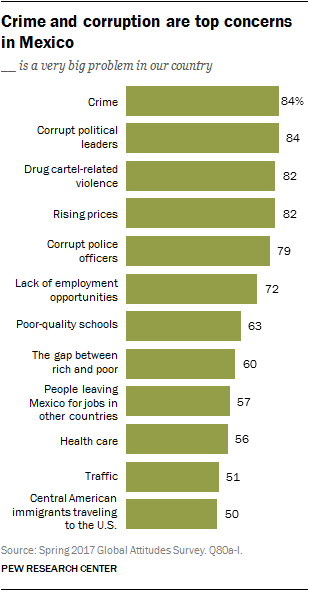
Harnessing mobilized disaster relief toward organized political reform is a tall task with many respected skeptics, but Mexico might be in a unique moment. First, while Mexico is a different nation than in 1985, the economy has stagnated. Mexico now ranks as the world’s 15th-largest economy, but nearly half the population lives below the poverty line and real GDP per worker still remains below its peak in 1980. Second, Mexico transitioned toward a multi-party democracy, with free and fair elections since 1996 overseen by the independent Federal Electoral Institute (IFE), and this could give hope to disconnected citizens. Third, violence and insecurity are at record highs, and conflict with the drug cartels has cost 200,000 lives and left 30,000 Mexicans missing. These three factors are all interconnected and are top concerns for Mexicans.
Crim ane Corruption Mexico Concerns

Mexico’s vastly unequal society affects its economy, democracy, and security, and has created a vicious cycle, documented by the New York Times. People with resources buy private security and housing in safer, segregated neighborhoods. Not experiencing the effects of violence, elites do not apply political pressure for reforms that benefit everyone in society. The poor become preyed on by cartels, subjected to violence every day, and abandoned by the state. Research by Brian J. Phillips, a political scientist at the Center for Research and Teaching in Economics (CIDE), shows that local inequality is the best predictor of vigilante groups, as the poor seek security. This has led Mexicans to believe, “el contrato social se rompió” – the social contract is broken.

The central challenge Mexico must confront is its political economy of inequality. That is a fundamental problem and the means to repair the social compact between the Mexican people and their government. The history of 1985 suggests that people mobilized for disaster relief can be organized for political change. A renewed national solidarity and modern social media has the potential to harness the power of citizenship and collective action, and turn this moment of tragedy into a movement for equality.

Trump Makes Anti-Americanism Great Again

MEXICO CITY—In a stark reversal, new evidence shows that Mexican views of the United States are at a decade and a half low with the presidency of Donald J. Trump. Survey research from the Pew Center indicates that about two-thirds of Mexicans now have a negative opinion of their northern neighbor, the mirror opposite from only two years ago. Mexico and the U.S. share a complicated, conflict-ridden history, yet anti-U.S. sentiment had diminished during recent decades of economic integration and increased immigration. The return of anti-Americanism is a regression in the bi-national relationship, reminiscent of the pre-NAFTA era and Iraq War period. This dramatic shift has political implications for the upcoming 2018 elections in Mexico, everyday diplomatic efforts on issues from migration to terrorism, and is illustrative of a lack of U.S. global leadership.

main favorability chart

President Trump kicked off his candidacy calling Mexicans “rapists and criminals,” questioning the ability of a judge to do his job because “he’s a Mexican” (he’s actually from Indiana like Vice President Pence), and boosting campaign chants to build a “big, beautiful wall” that Mexico will pay for. So, it’s no coincidence that only five-percent of Mexicans have confidence that Mr. Trump will “do the right thing regarding world affairs.” (This was 10-times higher under President Obama). With his divisive rhetoric and aggressive actions, Mr. Trump has made anti-Americanism great again in Mexico.

pew presidential approval chart

Left, right, and center, Mexicans across the political spectrum share similar unfavorable views of the United States. As my friend and Wilson Center political analyst Miguel Toro points out in his recent post, gridlock is growing in Mexican governance as elections approach. Yet what unites these disparate factions is their opposition to the policies of the Trump Administration (the wall, deportations, NAFTA abandonment, climate change). At a precarious moment in Mexican politics, anti-U.S. sentiment is on the rise and uniting a frustrated Mexican public.

pew differences in mexican economy.png

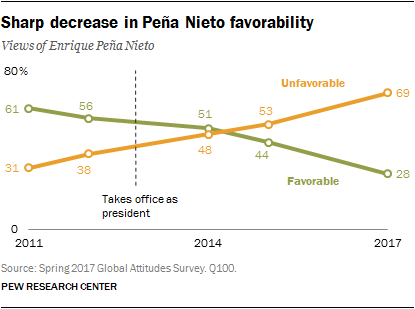
The national mood in Mexico is pessimistic and primed to scapegoat the U.S., which has historically been viewed with suspicion and distrust. According to the Pew Center survey, 85 percent of people are dissatisfied with the nation’s direction, with seven-in-ten expressing the economic condition to be bad. On the left, supporters of MORENA and PRD are particularly disappointed with the economy compared to people who identify with President Nieto’s PRI. Nieto favorability (28 percent) continues to fall and seven-out-of ten disapprove his handling of U.S. relations, which significantly decreased after inviting then-candidate Trump to Mexico in 2016. These conditions set up a Mexican presidential election centered on changing the nation’s course and combating a hostile U.S. President Trump.

Pew nieto favorability

Political strategist David Axelrod argues that voters tend to choose “the remedy, not the replica” in elections. President Nieto was widely seen as appeasing Mr. Trump during his campaign visit and as weak while insults are tweeted and natural disasters are ignored. A potential remedy for Mexican voters could be a strongman, nationalist from the left. I’m not the first political analyst to place Andrés Manuel López Obrador (AMLO) as the presidential frontrunner, and I’m concerned what the rise of populist nationalism and the return of anti-Americanism could mean for U.S.-Mexico relations. As Mexican presidential candidates bash the United States as a political piñata, Mr. Trump will respond with I-told-you-so rhetoric, and this escalation has the potential to poison U.S. views toward Mexico.

President Trump’s election reignited anti-Americanism in Mexico, but with different levels of intensity. Mexicans living near the northern border have more favorable views of the U.S. than those living farther away. Young, educated, and higher-income Mexicans also have more favorable views and, overall, one-in-three Mexicans would still chose to live in the United States if given the opportunity. In conversations with my former Chicago colleagues from Mexico, they expressed that their opinions of the U.S. also had changed, as they grappled with the role of race in U.S. politics. A nation renowned for its rule of law, freedom of speech, and defense of human rights, now seemed diminished. At a carne asada I attended after Charlottesville, many Mexicans were shocked that a neo-Nazi militia could take over a town, and appalled that a U.S. President would not condemn their violence and stand up for democratic values of equality and dignity.

“America’s ability to lead the world depends not just on the example of our power, but on the power of our example,” argues Joe Biden (former U.S. Vice President and America’s favorite uncle) in a recent New York Times op-ed. The world is not only watching, but reacting to the lack of global leadership from the White House with anti-Americanism. Declining Mexican attitudes toward the U.S. will hamper our bi-national ability to promote peace and prosperity in North America, and diminish the potential of millions of lives. Renewed leadership, on both sides of the border, is necessary to correct our course. I hope in the meantime that new voices from entrepreneurs to mayors, to civic activists and concerned citizens can fill the void.

Source: Vice, Margaret, and Hanyu Chwe. “Mexican Views of the U.S. Turn Sharply Negative.” Pew Research Center’s Global Attitudes Project, 14 Sept. 2017, www.pewglobal.org/2017/09/14/mexican-views-of-the-u-s-turn-sharply-negative/

My First Month in Mexico

MEXICO CITY—Flying from Houston, Texas on Southwest to start my Fulbright scholarship was surreal. At first, nothing felt foreign about forming an orderly queue with the occasional Spanish in the background. I was born and raised in San Antonio, a majority Latino city, and the capital of Mexico is the closest to home I’ve lived since pursuing college and graduate school outside of Texas. I always sleep on flights, and this was no different, yet I woke to a never-ending sea of urbanization, that is la Ciudad de México.

IMG_8469 2.JPG

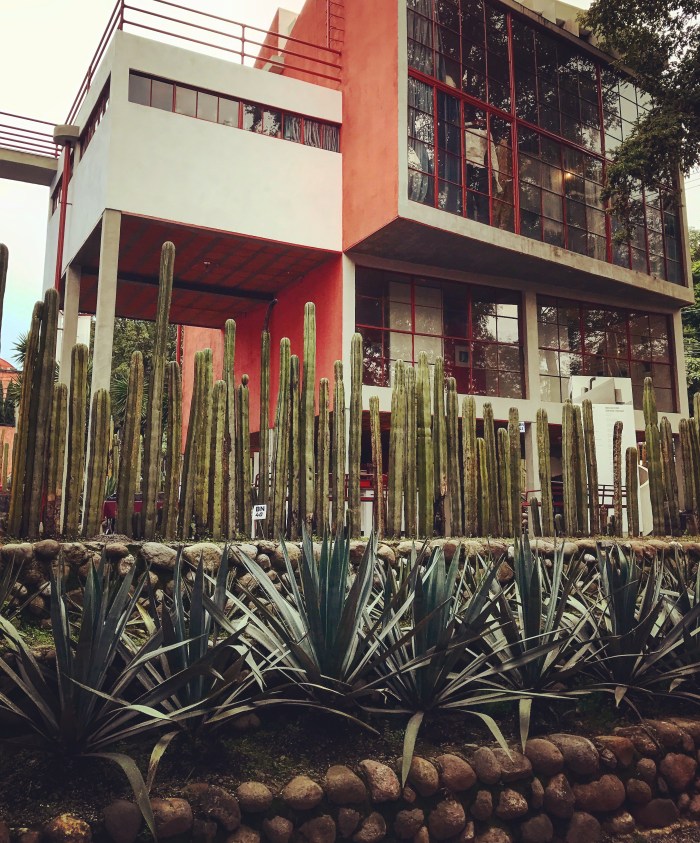
Similar to any major center, I took an Uber to get to my destination in San Angel, a historic barrio with cobblestone streets once home to the power couple of Diego Rivera and Frida Kahlo who loom large over this metropolis. Thanks to generous friends (a theme over the past month), I had a place to stay while I searched for my own. The next morning I had an appointment for an apartment in Colonia Roma, so I stored 5 pesos for the metro in my smallest pocket and started my next adventure. This was the first of many long walks alone in a new city that I now consider home.

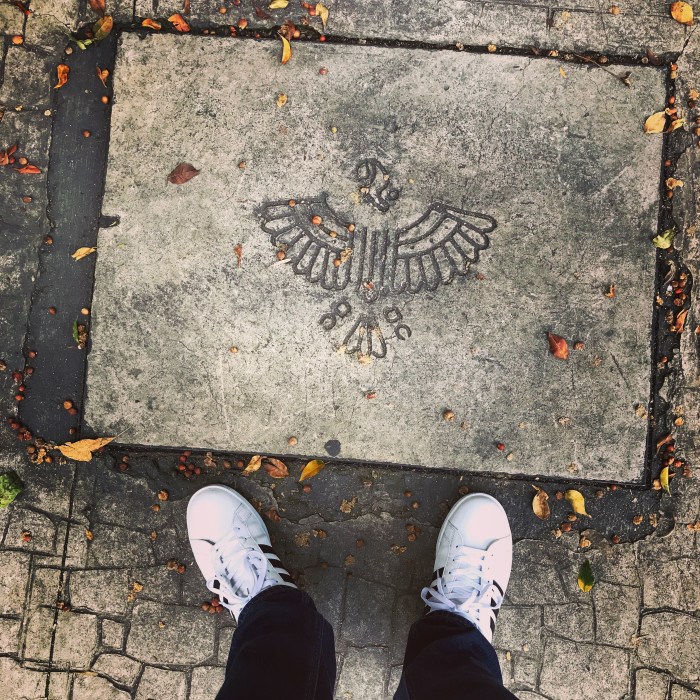
IMG_9093.JPG

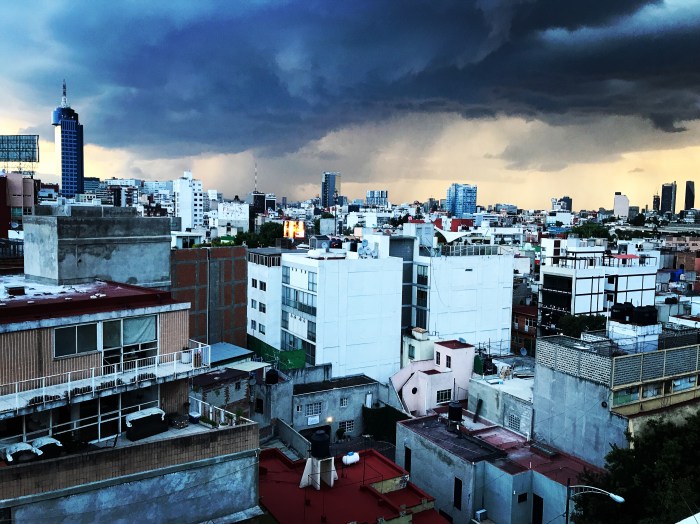
Perhaps I already feel at home because as I wonder through Mexico City I see flashes from my past, places that I had the honor of exploring and struggling in. El Palacio Postal is basically Gringotts out of Harry Potter’s Wizarding World (my favorite book series and what inspired my love of reading thanks to my grandma), and takes me back to epic gothic campuses of Boston College and UChicago, where I studied. Paseo de la Reforma reminds me of the Magnificent Mile in Chicago, Alameda Central echoes Hemisfair Park in San Antonio, Parque Lincoln in Polanco—where statues of Abe and MLK stare across the street from each other—prompts memories of Washington D.C., while the Torre Latinoamericana pierces the sky like the Prudential Tower in Boston. Those cities are all homes where I met friends and colleagues who shaped my principles and politics, and I am confident Mexico City will continue in that tradition.

IMG_9094.JPG

The city’s ambience is warm and vibrant with brightly colored buildings, laborers earning a living, and street vendors overwhelming human senses (and stomachs!). While exploring El Bazaar Sábado with friends, we listened to federal police perform as mariachis in the plaza and enjoyed enchiladas de pato en Coyoacán. At Palacio de Bellas Artes, the careers of Picasso and Rivera are contrasted in a unique exhibit, and the public murals are a must-see. Thanks to my foodie friends, I had already eaten at el Cardenal twice, and my new favorite drink has quickly become a carajillo, a cocktail concoction of Licor 43 and espresso. With my fellow Fulbrighters, we climbed to the top of the Catedral Metropolitana overlooking the Zócalo as decorations were on display for the upcoming el Día de la Independencia celebrations.

IMG_9095

Despite the dynamism of the city, there also is some somberness and a sense of isolation that I do not fully understand. Public transportation is relatively inexpensive, but rather slow and uncomfortable to the point of being unbearable during peak hours. Strolling through parks enables tranquility, but also a slight headache from the pollution above (maybe I just need to drink more water, less cerveza). While searching for housing, the issues of affordability and mobility were apparent as challenges that every city must confront. The dual-economy (formal and informal), which Dani Rodrik and Santiago Levy recently wrote about, is evident to the eye and must drain hope out of people’s aspirations. Whether it is DACA, NAFTA, or the Wall, the whims of the White House weigh on public discourse. After a month, Mexico City is a city of contrasts, one of beauty and opportunity, but perhaps only for a privileged few, and could be called la Ciudad de Desigualdad.

IMG_8643.JPG

Yet somehow out of this discordance is progress. While living in Mexico City over the next year, thanks to a Fulbright-García Robles research grant funded by both the United States and Mexican government, I’m going to explore what other cities can learn from CDMX. What public policies would promote more inclusive economic growth? Urban development should not be an end, but a means to improve people’s lives, particularly disadvantaged communities. Through all the immense pleasures this rich culture and magnificent city provides, I will have to grapple with the stark inequity of services and class cleavages that are a part of every day life. And like all the past places I’ve had the pleasure to call home, the wisdom from Mexico City will forever impact my perspective on life and my understanding of my own means to affect the lives of others.

This is an experiment. I have ideas that I want to test. I expect to be challenged, not only in speaking Spanish, but also about my beliefs and who I aspire to be. It’s a privilege to be able to learn and to explore in a new place, and I hope to share a small part here.